
Microdosing Semaglutide Chart: A Monthly Dose Guide For Josie Patients
A semaglutide microdosing chart that supports comfort, longevity, and gentle month-to-month increases.
This is some text inside of a div block.
July 23, 2025
What GLP-1 microdosing means, how lower doses work, and why outcomes may differ from standard dosing.

The Josie Team
Medically Reviewed by


GLP-1 microdosing refers to using a GLP-1 medication at doses below the initiation or maintenance levels studied in large randomized clinical trials. In practice, this means lowering medication exposure while the same GLP-1 receptor pathways remain active.
GLP-1 medications mimic the body’s natural glucagon-like peptide-1 hormone, which helps regulate blood sugar, slow gastric emptying, and increase satiety after meals. Because these effects influence both glucose regulation and appetite control, GLP-1 receptor agonists are used to treat type 2 diabetes and obesity. In large clinical trials, medications like semaglutide and tirzepatide have produced significant weight loss when used at standard treatment doses.
Common examples include Ozempic and Wegovy (semaglutide) and Mounjaro and Zepbound (tirzepatide).
Microdosing does not change the biological mechanism of these medications. It simply reduces medication exposure, which may lower receptor activation and make metabolic outcomes less predictable at doses that have not been studied in large clinical trials.
For that reason, microdosing is best understood as a dose-calibration strategy rather than a separate therapy.

Interest in GLP-1 microdosing has increased as medications like Ozempic, Wegovy, Mounjaro, and Zepbound have become more widely used for diabetes and obesity treatment.
Some patients experience gastrointestinal side effects when starting standard doses, while others prefer a slower titration approach to improve tolerance.
Public discussion has also expanded as midlife public figures such as Oprah Winfrey have spoken about weight management and menopause-related metabolic changes. As awareness of GLP-1 medications increases, more people begin exploring different dosing approaches, including microdosing.
Online communities have further amplified these conversations by sharing personal dosing experiences and strategies.
However, these discussions often occur outside structured medical guidance, which is why clinical context is important when evaluating whether lower dosing approaches are appropriate.
Understanding how microdosing fits into treatment requires looking at how GLP-1 medications work and how midlife physiology can influence medication response.
Standard dosing follows the initiation and maintenance levels studied in large randomized clinical trials, whereas microdosing refers to using doses below those studied ranges.
Both approaches activate the same GLP-1 receptor pathways. The difference lies in the level of medication exposure and whether outcomes at that exposure level have been validated in clinical research. Standard dosing has demonstrated metabolic results in large randomized trials, while microdosing operates at exposure levels that have not been formally evaluated in those studies.
Because both dosing approaches exist along the same dose-response curve, the biological mechanism remains unchanged. What changes is the degree of receptor activation and the level of certainty surrounding expected outcomes.
Here’s a table that highlights the key differences.
Microdosing modifies medication exposure rather than biological mechanism. The GLP-1 receptor pathway remains active, but lower exposure levels may produce smaller or less predictable metabolic effects because those ranges have not been validated in large trials.
Three factors determine how GLP-1 dosing should be interpreted:
For context, semaglutide is typically titrated from 0.25 mg weekly to a maintenance dose of 2.4 mg weekly in obesity trials. Tirzepatide is titrated from 2.5 mg weekly to maintenance doses up to 15 mg weekly. These maintenance ranges are where metabolic outcomes have been clinically validated in randomized studies.
Doses below those validated ranges are often described as “sub-therapeutic,” meaning they fall below the exposure levels that produced confirmed metabolic endpoints in those trials.
Because medication exposure influences receptor engagement, the degree of receptor activation influences the magnitude of metabolic response. When exposure is reduced, the degree of receptor activation may also decline, which makes the resulting metabolic effect less predictable at those lower doses.
This distinction defines what microdosing can and cannot reasonably be expected to accomplish. It can reduce medication exposure and sometimes improve tolerability, but it cannot assume the validated metabolic outcomes demonstrated at studied maintenance doses.
These maintenance ranges are where randomized clinical trials demonstrated consistent metabolic outcomes. Doses below these ranges are sometimes described as “sub-therapeutic” because they fall outside the exposure levels formally studied in large trials.
Hormonal shifts during perimenopause and menopause can influence how the body responds to GLP-1 medications. As estrogen and progesterone fluctuate, the metabolic baseline becomes less stable. When that baseline shifts, the response to a fixed medication dose can become less predictable.
Several midlife changes may contribute to this variability:
These shifts do not change how GLP-1 medications work, but they can influence how strongly a given dose affects appetite, glucose regulation, and medication tolerance. Because dose response can vary in this environment, dosing strategies such as microdosing are sometimes discussed as ways to adjust medication exposure.

Microdosing GLP-1 medications in midlife is sometimes discussed because hormonal changes can influence how the body responds to these medications. During perimenopause and menopause, shifts in estrogen, progesterone, sleep stability, and lean mass can alter insulin sensitivity, appetite regulation, and medication tolerance.
These physiological changes do not alter how GLP-1 medications work. They can, however, influence how strongly a given dose affects appetite, glucose regulation, and gastrointestinal tolerance.
For that reason, dose adjustments are often considered within a broader metabolic context rather than as isolated dosing tactics.
One way clinicians sometimes think about dose adjustments is through a simple sequencing model:
Stabilize → Calibrate → Accelerate → Preserve
This model is a conceptual way to describe how physiological factors can influence dosing decisions. It is not a treatment protocol and does not replace individualized medical care.
In this framework:
In this context, microdosing represents an adjustment in medication exposure rather than a standalone strategy. Hormonal stability, metabolic baseline, and lean-mass preservation continue to influence how GLP-1 therapy behaves regardless of dose level.
Semaglutide and tirzepatide both follow dose-response curves, and neither has clinical trials evaluating microdose protocols.
Both medications produce greater average metabolic effects at higher validated doses. Microdosing reduces exposure intensity, not receptor identity.
That distinction applies to both drugs.
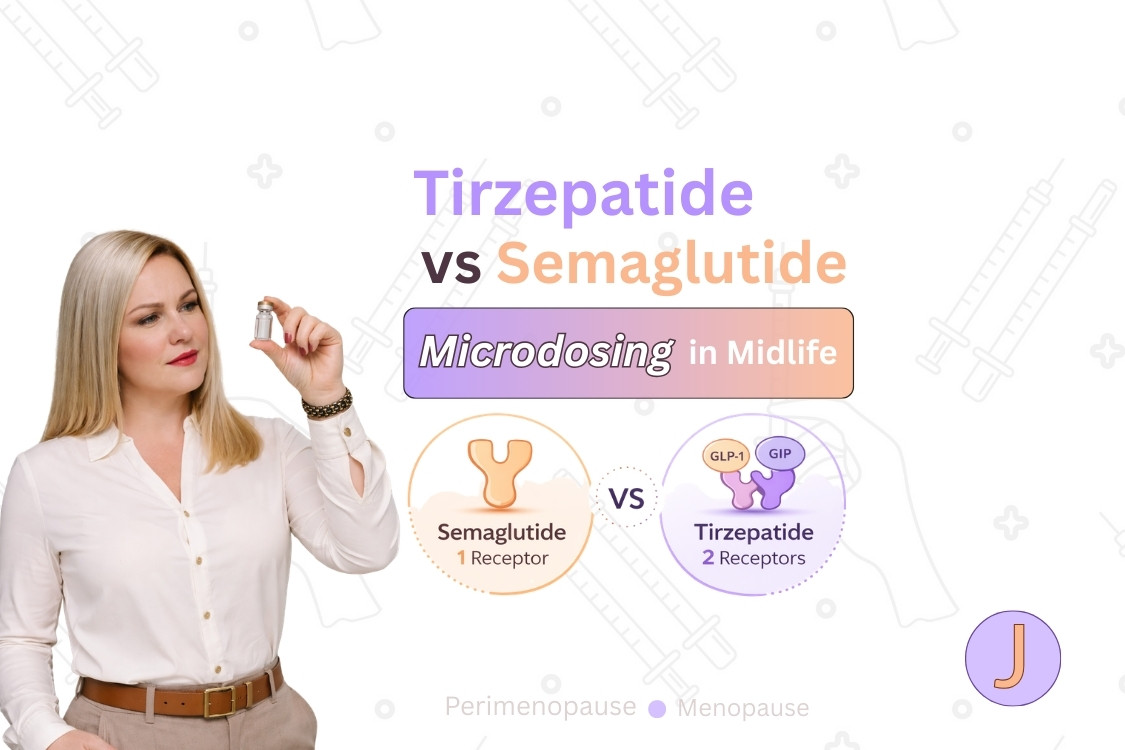
Semaglutide is a GLP-1 receptor agonist. It acts on GLP-1 receptors in the pancreas, hypothalamus, and gastrointestinal tract to modulate insulin secretion, satiety, and gastric emptying.
In the STEP 1 trial, semaglutide 2.4 mg weekly produced average weight reductions of approximately 14 to 15 percent over 68 weeks. Across the STEP trial program, dose escalation demonstrated a clear dose-response relationship.
Higher doses produce stronger receptor activation and larger metabolic effects.
Microdosing operates below those validated maintenance levels.
As a dual GLP-1 and GIP receptor agonist, tirzepatide produces metabolic effects that differ somewhat in magnitude from semaglutide. Our tirzepatide microdose dosing chart illustrates how lower and standard dosing ranges compare.
In the SURMOUNT-1 trial, higher maintenance doses of tirzepatide produced average weight reductions exceeding 20 percent in some dose groups. Like semaglutide, tirzepatide demonstrated a structured dose-response curve.
Greater dose intensity increases receptor activation, and stronger receptor activation increases the magnitude of metabolic change observed in clinical trials. Those larger metabolic effects are what define the validated outcomes at the studied maintenance doses.
Microdosing reduces exposure but does not remove GLP-1 or GIP activity. The biological pathways remain active, but receptor stimulation is lower. What remains undefined is whether sub-therapeutic doses produce clinically meaningful receptor engagement.
That gap exists for both medications.
Microdosing lowers medication exposure while the same receptor pathways remain active. What changes is the magnitude of receptor activation and the level of clinical validation.
Neither semaglutide nor tirzepatide has randomized trials defining metabolic durability at sub-therapeutic doses.
Microdosing may be considered in limited, supervised clinical scenarios. It is not intended to be a general entry strategy for GLP-1 therapy.
Its role is to adjust medication exposure when standard initiation levels are not tolerated, rather than to optimize outcomes by default.
Situations where calibrated lower dosing may be reasonable include:
These situations represent exposure-adjustment strategies, not alternative validated treatment protocols.
Lower doses may reduce some side effects, but they do not establish the metabolic outcomes demonstrated at the validated maintenance ranges in clinical trials. For that reason, any use of microdosing requires structured evaluation and ongoing medical oversight.
Supervision is the defining requirement. In practice, that supervision typically includes:
When dose adjustments occur without this type of monitoring, the process is no longer calibration. It becomes unsupervised experimentation.
Microdosing is not a validated alternative treatment protocol.
It is not an approved dosing pathway, a muscle-protection strategy, or a substitute for hormonal stabilization. Microdosing simply represents a lower level of medication exposure within a drug class whose validated outcomes were established at defined maintenance doses in clinical trials.
These boundaries reflect the structural limits of the available evidence.
Lower medication exposure does not change contraindications, eliminate evidence gaps, or replace stabilization of the metabolic environment.
Outside a structured framework, microdosing becomes a tactic without strategy.
Hormonal changes during perimenopause and menopause can influence insulin sensitivity, appetite regulation, and medication tolerance. Because GLP-1 medications interact with these same systems, the metabolic environment can affect how strongly a given dose works.
For that reason, microdosing is sometimes discussed as a way to adjust medication exposure when standard initiation doses are not well tolerated. Lowering the dose, however, does not replace the underlying factors that shape medication response.
When clinicians evaluate dose adjustments, they often consider factors such as:
Reducing medication exposure does not remove contraindications or eliminate the need for monitoring. Any GLP-1 dose adjustment should occur under the supervision of a qualified healthcare provider.
When dose adjustments follow physiological data and medical oversight, strategies such as microdosing function as structured exposure changes rather than informal experimentation.
GLP-1 microdosing generally refers to using a dose below the initiation or maintenance levels studied in large randomized clinical trials. These lower exposure levels have not been formally validated for long-term metabolic outcomes.
GLP-1 medications still activate the same biological pathways at lower doses, but clinical trials have not evaluated whether sub-therapeutic dosing produces consistent or durable weight loss outcomes.
Lower doses may reduce some side effects, but safety still requires medical screening, contraindication review, and clinician supervision.
Some clinicians may adjust dosing off-label when patients cannot tolerate standard initiation doses, but there is no approved microdosing protocol for these medications.
Some clinicians prescribe compounded GLP-1 medications when commercially manufactured products are not appropriate or available. In those cases, lower or more gradual dosing adjustments may be possible because compounded medications are prepared in different concentrations.
However, compounded medications are not FDA-approved finished drug products, and dosing strategies such as microdosing have not been evaluated in randomized clinical trials. Any use of compounded GLP-1 medications should occur under the supervision of a qualified healthcare provider.
Situations where microdosing may be considered under medical supervision include:
Situations where microdosing should not replace standard care include:
GLP-1 microdosing refers to using a lower level of medication exposure within a structured clinical framework. It is not a separate therapy and it is not a validated alternative dosing protocol.
Standard GLP-1 dosing carries outcome data at defined maintenance ranges established in randomized clinical trials. Microdosing operates below those validated exposure levels. The biological mechanism remains active, but the magnitude and durability of metabolic effects at those lower doses have not been established in clinical trials.
In midlife physiology, dose decisions should reflect hormonal status, metabolic baseline, and lean mass preservation strategy. When exposure adjustments occur within that structure and under clinician supervision, microdosing functions as calibration rather than a standalone treatment strategy.
Physiological Reviews.
Glucagon-Like Peptide-1 Physiology.
https://journals.physiology.org/doi/full/10.1152/physrev.00034.2006
New England Journal of Medicine.
Once-Weekly Semaglutide in Adults with Overweight or Obesity (STEP-1 Trial).
https://www.nejm.org/doi/full/10.1056/NEJMoa2032183
New England Journal of Medicine.
Tirzepatide Once Weekly for the Treatment of Obesity (SURMOUNT-1 Trial).
https://pmc.ncbi.nlm.nih.gov/articles/PMC8554369/