

Microdosing Semaglutide Chart: A Monthly Dose Guide For Josie Patients
A semaglutide microdosing chart that supports comfort, longevity, and gentle month-to-month increases.
This is some text inside of a div block.
July 23, 2025
How tirzepatide and semaglutide compare for GLP-1 microdosing and why menopause may affect response.

The Josie Team
Medically Reviewed by

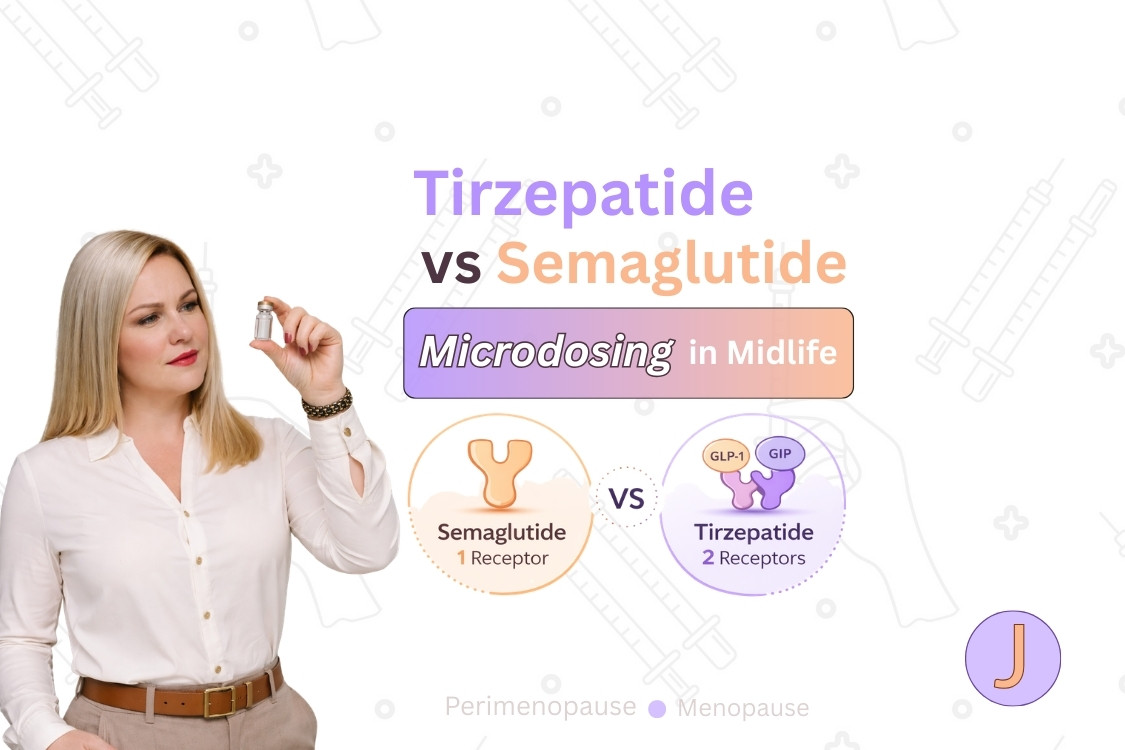
Some people exploring GLP-1 medications talk about microdosing, which means using amounts lower than the doses studied in large clinical trials. Both semaglutide and tirzepatide are GLP-1 medications that influence appetite signals and blood sugar regulation. At standard doses, they are used to treat obesity and type 2 diabetes.
Microdosing discussions focus on something different: whether very small exposures to these medications can influence appetite or metabolic signals without the stronger effects seen at full therapeutic doses.
Because tirzepatide and semaglutide activate incretin hormone pathways differently, people often wonder whether one medication behaves differently than the other at lower doses. Interest in this question has grown among women in perimenopause and menopause, when metabolism, appetite signals, and body composition begin to change.
This article explains how each medication works, what research shows at studied doses, why microdosing discussions exist, and why menopause may influence how these medications feel.
Important: Microdosing has not been evaluated in large randomized clinical trials.
Both tirzepatide and semaglutide belong to the incretin therapy class. Incretin medications work by mimicking hormones the gut produces naturally after eating. These hormones support insulin secretion, slow gastric emptying, and send satiety signals to the brain.
Because both medications act on appetite and glucose metabolism, they are the two most commonly compared options when people research GLP-1 microdosing. People drawn to microdosing often want the metabolic benefits of these therapies at a level that feels more tolerable:
Understanding what makes these two medications similar, and what sets them apart, is key to understanding why the comparison matters. It also helps explain how GLP-1 microdosing is being explored during perimenopause and menopause, where hormonal shifts can influence dose tolerance and treatment experience.
Both medications work on the same general territory: appetite regulation, glucose control, and body weight. But they activate receptors differently. That difference is not just technical. It can shape the experience of taking them.
Semaglutide targets one receptor. Tirzepatide targets two. What that means at lower doses is still being studied. Before getting into how microdosing may feel different between the two, it helps to understand how each medication works.
When people search for tirzepatide vs semaglutide microdosing, they are usually trying to understand how the two medications differ at very low exposure levels. The table below highlights the key differences. Keep in mind that microdosing is not a studied protocol. The comparisons reflect what large clinical trials have evaluated at standard doses.
Neither medication has been studied in clinical trials at microdose levels. The trial data above reflects outcomes at full therapeutic doses only.
Microdosing strategies are not standardized in clinical research. However, some providers use gradual dose exposure to help patients adapt to GLP-1 medications while monitoring tolerance.
At Join Josie, treatment plans are individualized and overseen by licensed providers. The supervising physician for Josie programs is Dr. Ana Lisa Carr, MD, a physician who focuses on women’s health and metabolic care.
We offer
The example below illustrates how a gradual microdosing approach may look for some patients using tirzepatide or semaglutide. Actual dosing decisions depend on provider evaluation, patient tolerance, and treatment goals.
These medications do not work identically. Understanding the difference starts with understanding what incretin hormones are and why activating more than one receptor changes things.

GLP-1 is a hormone the gut releases naturally after eating. It tells the brain you are full, prompts the pancreas to release insulin, and slows gastric emptying so food moves through the stomach more gradually.
Semaglutide mimics this hormone by binding to GLP-1 receptors in the brain and gut. The result is reduced appetite, better blood sugar regulation, and slower digestion. Because semaglutide stays active much longer than the natural hormone, it provides sustained appetite suppression across the week.
This is the mechanism behind Ozempic, approved for type 2 diabetes, and Wegovy, approved for chronic weight management. At full therapeutic doses, semaglutide produces meaningful weight loss. The same potency is also why some people experience nausea, particularly when doses are increased too quickly.
Tirzepatide activates two appetite-related hormone signals instead of one. It targets both the GLP-1 receptor and a second receptor called GIP, which stands for glucose-dependent insulinotropic polypeptide.
GIP is another incretin hormone produced in the gut. It also plays a role in insulin secretion and fat metabolism. By activating both pathways at the same time, tirzepatide may produce broader effects on appetite and metabolic regulation than a single-pathway approach.
This dual incretin signaling is what makes tirzepatide biologically distinct from semaglutide. It is the mechanism behind Mounjaro, approved for type 2 diabetes, and Zepbound, approved for chronic weight management.
Microdosing means using these medications at amounts lower than the levels studied in clinical trials. That reduction in dose means less receptor activation. Less signal reaches the brain and gut. Appetite suppression becomes milder. Side effects may be fewer.
With semaglutide, lower doses reduce signaling through the GLP-1 pathway alone. The appetite-reducing and digestion-slowing effects become weaker, but they are still working through the same single receptor system.
With tirzepatide, lower doses reduce signaling through both the GLP-1 and GIP pathways at the same time. Because tirzepatide activates two receptors rather than one, the biological response to reduced exposure may not mirror semaglutide directly. How the two pathways behave at very low activation levels is not yet well understood.
This does not mean tirzepatide is better or worse at low doses. It means the experience may be different in ways that are hard to predict from the available research.
Individual responses to low doses also vary widely. Two people taking the same low dose of either medication may have completely different experiences based on their baseline metabolism, gut motility, hormonal environment, and sensitivity to receptor signaling.
Microdosing strategies fall below the dose ranges evaluated in large randomized clinical trials. Understanding the difference between microdose exposure and full therapeutic dosing helps clarify why low-dose experiences may not match the outcomes reported in trial data.

GLP-1 medications follow a general pattern called a dose-response relationship. As medication exposure increases, receptor activation increases. Appetite suppression, glucose regulation, and digestive slowing typically become stronger as dose intensity rises.
Clinical trials evaluate medications across specific dose ranges in order to understand where meaningful metabolic effects occur and where side effects become more likely.
Microdosing discussions focus on the lower end of this curve. At those levels, receptor activation may still occur, but the intensity of the signal is smaller and less predictable.
Because tirzepatide activates two receptors (GLP-1 and GIP) while semaglutide activates one (GLP-1 only), the shape of this dose-response relationship may differ between the medications. However, clinical trials have only evaluated both drugs within therapeutic dose ranges. What happens below those levels has not been studied in controlled research.
Microdosing discussions generally refer to the first category in this curve, where medication exposure is below the dose ranges evaluated in clinical trials.
Microdosing discussions often reference full-dose research because those trials are the only rigorous data available for understanding how these medications behave.
Large clinical trials study these medications at the doses approved or under evaluation by the FDA. Those doses are meaningfully higher than what microdosing discussions typically involve. The trial data is the strongest evidence available for understanding how these medications perform.
The STEP-1 randomized clinical trial evaluated semaglutide 2.4 mg weekly in adults with obesity over 68 weeks. Participants achieved an average weight loss of approximately 14.9% of body weight.
That is a substantial result. Side effects, primarily nausea and gastrointestinal symptoms, were more common during dose escalation. Most participants tolerated the medication well by the end of the study period.
The SURMOUNT-1 randomized clinical trial evaluated tirzepatide at three dose levels: 5 mg, 10 mg, and 15 mg weekly in adults with obesity. Weight loss outcomes were larger than those seen in the STEP trials. The highest dose group achieved average reductions of around 20% of body weight.
Multiple dose groups were evaluated, giving a picture of how the medication performs across a range of intensities. Even at lower studied doses, outcomes were meaningful.
SURMOUNT-5 was the first large randomized clinical trial to compare tirzepatide and semaglutide directly at their respective maximum studied doses. Tirzepatide produced greater reductions in both body weight and waist circumference compared to semaglutide.
This does not mean tirzepatide is the right choice for everyone. Tolerability, cost, access, and individual response all matter. But the head-to-head data confirms that the two medications are not equivalent in their effects at therapeutic doses.
These outcomes come from full-dose studies. They cannot be used to predict what will happen at microdose levels, where no comparable trial data exists.
GLP-1 medications do not act in isolation. Their effects depend on the metabolic environment they enter. That matters enormously for women navigating perimenopause or menopause, because that environment is actively changing.
Hormonal shifts during this life stage affect insulin sensitivity, appetite signaling, gastric emptying, and body composition. The same dose of a medication may land differently in a body whose metabolic baseline has shifted. Some women find that GLP-1 medications feel stronger or produce more side effects during hormonal transitions. Others find their bodies respond differently to appetite suppression than they did before menopause.
Recognizing these factors is not about predicting outcomes. It is about understanding that midlife is not a neutral backdrop for medication use.
Estrogen plays a meaningful role in how the body handles energy. It supports insulin sensitivity, helps regulate fat distribution, and interacts with appetite-regulating systems in the brain.
As estrogen declines during perimenopause and menopause, insulin sensitivity can decrease. The body may store more fat, particularly around the abdomen. Appetite signals can become less consistent. These changes do not happen identically in every woman, but they are common enough to shape how medications are experienced.
GLP-1 and GIP receptors are present in areas of the body where estrogen also acts. This suggests there is biological overlap between hormone changes and incretin signaling, though the precise interactions are still being studied.
Some observational studies have noted improved weight management outcomes when GLP-1 therapy is combined with hormone therapy in menopausal women. The idea is that restoring estrogen levels may support a more favorable metabolic environment, one where appetite-regulating medications can work more effectively.
This is promising, but the evidence is observational. That means it reflects patterns seen in groups of patients, not controlled experimental data. Individual variation is significant, and this combination should only be considered with guidance from a knowledgeable provider.
GLP-1 medications can lead to significant calorie reduction and rapid weight loss. Not all of that weight loss comes from fat. Some of it can come from lean muscle mass, which is a concern that becomes especially important during menopause, when maintaining muscle is already more challenging.
Muscle mass supports metabolism, balance, and daily function. Losing it during a weight loss period can undermine long-term health even if the scale shows progress. Preserving muscle during GLP-1 therapy requires intentional effort in two areas: movement and nutrition.
Resistance exercise is the most effective tool for preserving and building lean muscle mass during a caloric deficit. It signals the body to hold onto muscle tissue even as overall body weight decreases.
Strength training also supports metabolic regulation, since muscle tissue is metabolically active. For women in midlife, regular resistance exercise improves functional strength, supports bone density, and has well-documented benefits for body composition. For guidance on getting started, see our strength training resource for women.
When appetite is suppressed, total calorie intake drops, sometimes significantly. That reduction in eating can also mean a reduction in protein, which the body needs to maintain and repair muscle tissue.
Prioritizing protein-rich meals and snacks helps ensure the body has what it needs for muscle retention, even when overall appetite is low. Protein is also more satiating than carbohydrates or fat, which can support steady energy throughout the day. Eggs, lean meats, legumes, Greek yogurt, and cottage cheese are practical high-protein options that do not require large volumes of food.
Discussions about GLP-1 microdosing often involve compounded medications, which are versions of tirzepatide or semaglutide mixed by compounding pharmacies rather than manufactured by the original drug maker.
Compounded medications are not FDA-approved. They are not held to the same manufacturing standards, and their dose accuracy can vary. Dosing errors with compounded GLP-1 medications have been reported, including cases where patients received doses that were too high or improperly measured.
This is not a reason to dismiss every compounded option, but it is a reason to approach this space carefully. Anyone using a compounded GLP-1 medication should work with a licensed provider who understands the sourcing, dosing, and monitoring involved. Self-directed microdosing with unverified compounded products carries meaningful risk.
At therapeutic doses, tirzepatide has shown greater weight loss outcomes in head-to-head trials. Whether that holds at microdose levels is unknown. No clinical trial data exists for either medication at those exposure levels. The dual-pathway mechanism may produce a different experience, but individual responses vary widely. At Josie, Dr. Ana Lisa Carr personalizes your microdose based on your goals and biology - see our chart on microdosing tirzepatide to get a visual understanding of a typical case.
Microdosing discussions involve both medications, though semaglutide appears more frequently because it has been available longer and is more widely prescribed. Tirzepatide is newer, but interest in its use at lower doses is growing, particularly as head-to-head data comparing the two medications has emerged.
No. The FDA approves medications at specific dose ranges studied in clinical trials. Using these medications at lower levels than those studied ranges is not a recognized or approved protocol. Anyone pursuing this approach should do so with a licensed provider and a clear understanding of what is and is not supported by evidence.
Lower doses generally produce less receptor activation, which can mean fewer or milder side effects. Many people experience nausea primarily during dose escalation at therapeutic levels. At very low doses, that side effect burden may be reduced. However, reduced side effects at lower doses may also reflect reduced therapeutic effect. There is no clinical data that defines a reliable lower dose threshold for microdosing.
Compounded GLP-1 medications are not FDA-approved and have been associated with dosing errors. Using them without proper medical supervision adds risk. If someone is considering this approach, working with a licensed provider who can oversee dosing, sourcing, and any side effects is essential.
There is no clinical data that directly answers this for menopausal women. Both medications affect appetite and digestion, and both interact with the metabolic changes of menopause. Individual experience varies too much to generalize. A provider familiar with both medications and midlife hormonal health is the best resource.
This article is for educational purposes only and does not constitute medical advice. Always consult a qualified healthcare provider before starting, stopping, or changing any medication.
ClinicalTrials.gov.
SURMOUNT-5: Tirzepatide vs Semaglutide for Weight Management.
https://clinicaltrials.gov/study/NCT05822830
The New England Journal of Medicine.
Once-Weekly Semaglutide in Adults with Overweight or Obesity (STEP-1 Trial).
https://www.nejm.org/doi/full/10.1056/NEJMoa2032183
The New England Journal of Medicine.
Tirzepatide Once Weekly for the Treatment of Obesity (SURMOUNT-1 Trial).
https://www.nejm.org/doi/full/10.1056/NEJMoa2206038