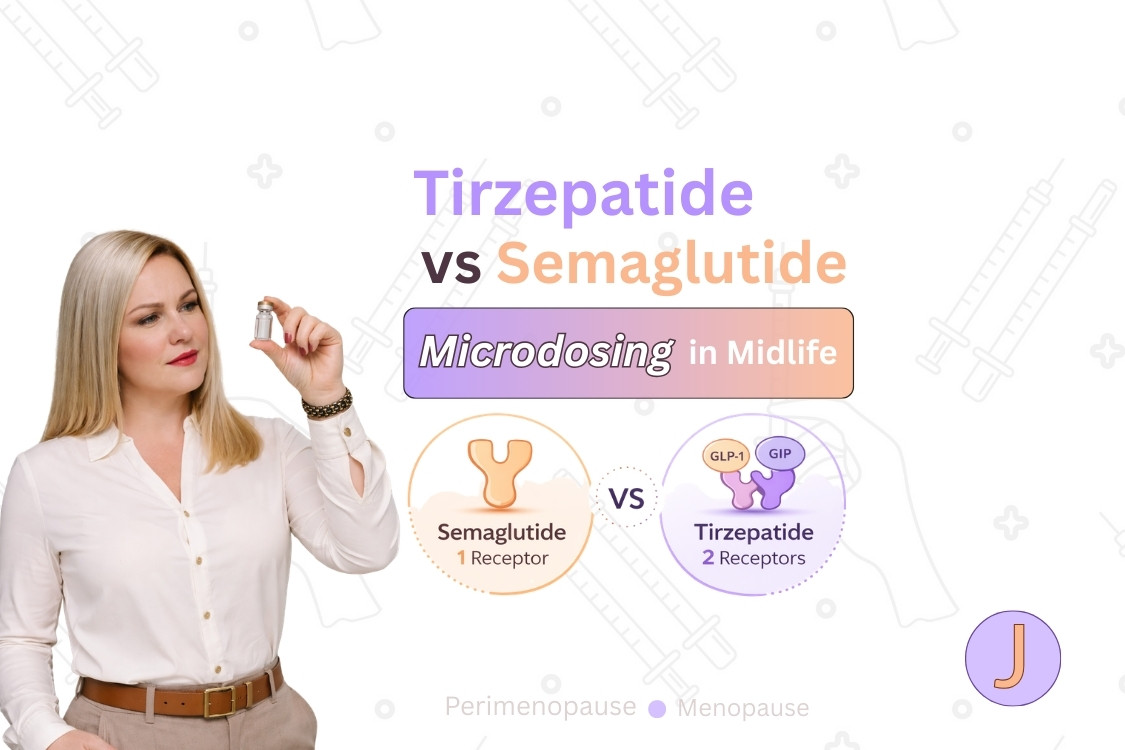

Microdosing Semaglutide Chart: A Monthly Dose Guide For Josie Patients
A semaglutide microdosing chart that supports comfort, longevity, and gentle month-to-month increases.
This is some text inside of a div block.
July 23, 2025
Noticed shape changes around your glutes during GLP-1 weight loss? Here's why it happens and what may help.

The Josie Team
Medically Reviewed by


This article is for educational purposes only and is not medical advice. Compounded GLP-1 medications are not FDA-approved and have not been evaluated by the FDA for safety, effectiveness, or quality. A licensed provider must review your health history before any prescription is written. Always discuss medication, exercise, and nutrition plans with a licensed healthcare provider before making changes. Individual results vary.
After working with many women over 40 navigating weight changes alongside GLP-1 therapy, one question comes up often:
"How do I address Ozempic butt?"
The good news is that with provider input and a thoughtful plan, many women may see shape changes improve over time. You may not need to stop your medication or choose between weight management and rebuilding shape. With the right approach (developed in partnership with a licensed provider), shape and firmness can be a focus alongside continued progress.
Some Josie community members have shared positive results when they pair provider-guided GLP-1 therapy with a structured strength routine, though individual experiences differ. Here's an educational overview.
A proven approach is progressive-overload strength training, which may help many women restore shape alongside GLP-1 therapy when discussed with a licensed provider. As your muscles gradually take on more resistance, the glutes may lift, round, and reshape over time. Individual results vary.
Some women in the Josie community may use a structured program through the Simply Strong App because it's designed for midlife bodies. The workouts are intended to balance muscle building with recovery. Always discuss new exercise routines with your licensed provider first, especially if you have health conditions or are early in GLP-1 treatment.
Many women choose three days per week:
Women who prefer four days per week often do:
To support muscle alongside weight changes, many people also focus on (in partnership with their licensed provider or registered dietitian):
Together, this combination may support shape rebuilding for some women, even while weight changes continue. Individual results vary.
If you're wondering why this kind of change can show up quickly in midlife, the next section explains the mechanism.
GLP-1 medications are designed to influence appetite signaling, which may help some patients eat less. When weight comes off quickly, the body may lose both fat and muscle, especially when strength training and protein aren't dialed in. This is something to discuss with your prescribing provider as part of your overall plan.
For midlife women, this may happen more visibly because estrogen is declining. Estrogen plays a role in where the body stores fat, how the body maintains muscle, and how firm skin and connective tissue feel. When levels drop, the hips and glutes may be among the first areas to show changes during weight loss.
This is why some people use the casual term "Ozempic butt" to describe changes in glute volume, firmness, or shape during rapid GLP-1 weight loss, especially in perimenopause and menopause.
There is nothing inherently "wrong" with your medication or your body. The body may simply be responding to:
Once you understand the mechanism, the conversation with your provider becomes more focused. For many people, the conversation is about supporting muscle and firmness, not stopping treatment.
Many people may continue GLP-1 therapy while working on muscle-building, but any changes to medication should be discussed with a licensed clinician. Don't change your medication on your own.
Stopping medication generally doesn't rebuild shape on its own. Shape often comes from muscle. When the glutes are trained with progressive overload, paired with adequate protein and recovery, shape may be supported alongside ongoing weight changes. Individual results vary.
Some Josie community members choose to stay on their current dose while focusing on muscle work. Others discuss adjusting their pace of fat loss with their licensed provider. Both approaches require provider guidance. The right path depends on your individual health picture and your clinician's recommendation.
If you're wondering whether your provider may discuss dose adjustments or microdosing to support a more gradual pace, the next section explains when that conversation may make sense.
Some patients discuss microdosing with their providers when weight loss is happening faster than feels sustainable for their body. Any decision about microdosing or dose adjustment is made by a licensed clinician based on your individual health picture. Don't change your dose on your own.
Microdosing does not replace strength training. It may simply allow a slower pace of fat loss for some patients, which may make supporting muscle easier. Talk to your provider if any of these apply:
Microdosing isn't right for everyone, and it isn't a substitute for clinical care. Your provider will help you weigh whether a different pace fits your situation.
Learn more about microdosing GLP-1s in menopause, and review our microdosing tirzepatide chart for an overview of what some dosing schedules look like. Final dosing decisions are always made by your licensed provider.
If you're curious about timing for visible changes, the next section covers what's realistic.
Some women report changes within a month, though timelines vary significantly from person to person.
Estimated ranges (these are not guarantees and individual experiences differ):
Consistency tends to matter more than perfection. Even if life gets busy, staying with the plan most of the time may continue to support progress. Discuss expectations and timelines with your licensed provider, since results vary based on individual factors.
Now that you have a sense of the timeline, here's a sample workout plan to discuss with your provider before starting.
This is a sample workout plan for educational purposes. Discuss any new exercise routine with your licensed provider before starting, especially if you have health conditions, are early in GLP-1 treatment, or have any joint or cardiovascular concerns. Stop if you feel pain or discomfort and consult your provider.
The plan trains every major muscle group while including extra glute work in each session. It can be done at home or in a gym.
Choose one of the following each week (and discuss progression with your provider as you go):
You don't need long workouts to see meaningful change. About 30-minute workouts may be enough when the plan is intentional and progressive, though individual recovery capacity differs.
"Ozempic butt" isn't a failure, and it isn't necessarily permanent. It's typically a sign of concurrent fat and muscle loss alongside hormonal changes. By prioritizing strength, protein, daily movement, and recovery (while working with your healthcare team), you may support shape alongside continued progress on the scale. Individual results vary.
With consistent effort, many people see improvement and feel better in their bodies. The most important factor tends to be consistency over perfection. A structured plan, developed with your licensed provider, may help you feel firmer and more defined over time.
You don't necessarily have to stop your medication. The most useful first step is a conversation with your prescribing provider about how to support muscle, shape, and overall well-being alongside your treatment.
Compounded GLP-1 medications, including compounded semaglutide and tirzepatide, are not FDA-approved. They are prepared by licensed compounding pharmacies for individual patients when a licensed provider determines a commercially available product is unsuitable. Discuss benefits, risks, and alternatives with your healthcare provider.
Josie is a telehealth platform that connects eligible patients with licensed providers; Josie is not the compounding pharmacy. Final prescribing decisions are made by a licensed provider based on your individual health history.
If you'd like to start a conversation with a licensed provider, take Josie's short intake. The intake is an information-gathering form, not a diagnosis or eligibility determination.
This article is for educational purposes only and is not a substitute for professional medical advice. Individual results vary. Timelines, costs, and outcomes can differ by pharmacy, insurance, and individual factors. Compounded GLP-1 medications are not FDA-approved and may differ from branded products in formulation, strength, or delivery method. Compounded GLP-1s are not equivalent to and should not be considered substitutes for brand-name medications unless a licensed provider determines a commercially available product is unsuitable. Josie is a telehealth platform that connects eligible patients with licensed providers; Josie is not the compounding pharmacy. Sample workouts, protein recommendations, and timeline estimates are educational examples only and are not personalized exercise, nutrition, or medical prescriptions. Discuss any new exercise or nutrition plan with a licensed healthcare provider before starting, especially if you have any health conditions, take medications, or are pregnant or nursing. Common side effects with GLP-1 medications can include nausea, bloating, fatigue, and constipation. Serious adverse events are rare but possible. Always talk with a licensed healthcare provider about the risks, benefits, and alternatives before starting or stopping any medication.