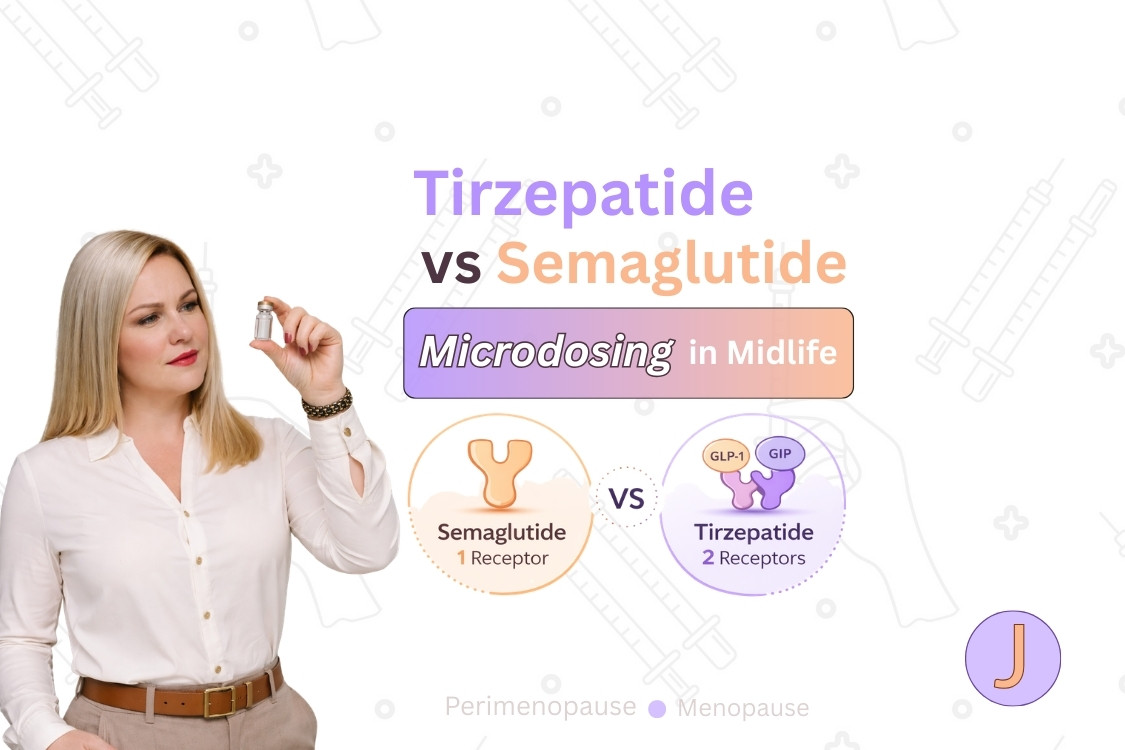

Microdosing Semaglutide Chart: A Monthly Dose Guide For Josie Patients
A semaglutide microdosing chart that supports comfort, longevity, and gentle month-to-month increases.
This is some text inside of a div block.
July 23, 2025
Why GLP-1 medications can feel different after 40 and what hormonal changes have to do with it.

The Josie Team
Medically Reviewed by

.jpg)
Many women notice something surprising when they start GLP-1 medications in their 40s or 50s. The medication works, but the experience can feel different than expected.
Some women see steady weight loss. Others deal with stronger nausea, slower progress, or more ups and downs during dose increases.
When people talk about GLP-1 response changing after 40, they are usually referring to differences in how the body reacts to the same dose. These differences can include how quickly weight loss occurs, how strong appetite suppression feels, or how easily someone tolerates dose increases.
GLP-1 medications mimic the body’s natural glucagon-like peptide-1 hormone. This hormone helps regulate blood sugar, slows gastric emptying, and strengthens satiety signals in the brain after meals.
Because of these effects, GLP-1 therapies are used to help control blood sugar and support weight loss.
The medication itself has not changed. What often changes during midlife is the hormonal and metabolic environment those signals operate within.
As hormone levels shift after 40, the same GLP-1 dose can feel different from person to person. Understanding why that happens can make the treatment process easier to interpret.

In simple terms, GLP-1 response after 40 becomes less predictable because the medication is interacting with a body that is undergoing hormonal and metabolic change.
GLP-1 receptor agonists are medications that mimic the action of glucagon-like peptide-1, a hormone released in the gut after eating.
This hormone helps regulate metabolism through several coordinated mechanisms:
Together, these effects help improve blood sugar regulation and reduce calorie intake.
Importantly, these biological mechanisms do not change with age. What can change over time is the metabolic environment those mechanisms operate within. Hormonal shifts, muscle loss, sleep disruption, and digestive changes during midlife can influence how strongly these mechanisms translate into weight loss or side-effect sensitivity.
Clinical trials help researchers understand how medications perform across large populations. For GLP-1 medications, studies such as the STEP trials for semaglutide and the SURMOUNT trials for tirzepatide showed that higher doses generally produce greater average weight loss and metabolic improvements.
These studies help establish dosing schedules and expected outcomes.
However, clinical trials describe population averages rather than individual responses. Participants can differ widely in age, hormone status, muscle mass, sleep patterns, and overall metabolic health. These differences influence how someone experiences a given medication dose.
For women in perimenopause and menopause, these factors can shift more rapidly. Hormonal changes, body composition changes, sleep disruption, and digestive changes can all influence metabolism and medication tolerance.
Because of this, two women taking the same GLP-1 dose may experience different levels of appetite suppression, weight loss, or side-effect sensitivity.
As a result, real-world experiences with GLP-1 medications do not always follow the exact pattern seen in clinical trials. Some women may notice stronger appetite suppression, others may experience more noticeable side effects during dose increases, and some may see weight loss occur at a slower or faster pace.
These differences reflect normal biological variability rather than a failure of the medication.
Clinical evidence provides the framework for safe dosing. Individual physiology determines how those results appear in practice.
After 40, estrogen levels begin to decline during the transition toward menopause. This shift can influence how the body regulates blood sugar and stores energy.
Estrogen supports insulin sensitivity, which allows the body to use glucose efficiently for fuel. As estrogen levels decrease, insulin signaling can become less efficient, meaning the pancreas may need to release more insulin to manage the same amount of glucose.
Research suggests insulin resistance can increase by about 10 to 20 percent during the menopausal transition, even when age and body weight are taken into account.
Because GLP-1 medications influence both appetite regulation and glucose metabolism, changes in insulin sensitivity can affect how strongly a given dose works in the body.
When insulin sensitivity is shifting, the metabolic response to a GLP-1 medication may vary more from person to person. The medication mechanism stays the same, but the metabolic environment surrounding it has changed.
Muscle mass naturally declines with age, and the rate of loss often accelerates during the menopausal transition.
Researchers estimate that adults lose about 3 to 8 percent of muscle mass per decade beginning in midlife. Because muscle tissue burns more energy than fat tissue, this gradual loss can lower resting metabolic rate over time.
When resting metabolic rate decreases, the body burns fewer calories at rest. That means the same level of appetite suppression from a GLP-1 medication can produce different weight loss outcomes depending on a person’s muscle mass and activity level.
Clinical trials also show that some lean mass loss occurs during weight reduction with GLP-1 medications. In the STEP-1 trial evaluating semaglutide, about 38 to 40 percent of total weight lost included lean mass.
For women already experiencing age-related muscle decline, preserving lean tissue becomes an important part of long-term metabolic health.
The relationship between muscle mass and weight-loss response can be summarized as a metabolic chain:
Resistance training and adequate protein intake can help support muscle maintenance during weight loss. Many experts recommend around 1.2 to 1.6 grams of protein per kilogram of body weight per day for adults aiming to preserve muscle while losing fat.
During the menopausal transition, progesterone levels often fluctuate and gradually decline. Progesterone helps support healthy sleep patterns, so when levels become less stable, sleep can become lighter or more fragmented.
Many women notice these sleep changes during perimenopause.
Sleep disruption can influence how the body handles stress and digestive signals. When sleep quality declines, stress hormones such as cortisol may increase, which can make the body more sensitive to nausea or gastrointestinal discomfort.
Several changes can occur at the same time:
GLP-1 medications commonly cause temporary gastrointestinal side effects during dose increases. When sleep is already disrupted, those side effects may feel more noticeable for some women.
This does not mean GLP-1 medications are less effective after 40. It simply means tolerance to dose increases may vary more during periods of hormonal transition.
GLP-1 medications slow gastric emptying, which means food moves through the stomach more slowly. This effect helps control blood sugar levels and prolong feelings of fullness after meals.
Clinical studies show that GLP-1 therapies can delay gastric emptying by about 30 to 50 percent during early treatment, although this effect often becomes less pronounced over time as the body adapts.
During perimenopause and menopause, changes in hormone levels can also influence digestive function. Some women notice shifts in gut motility, bloating, or changes in how quickly food moves through the digestive system.
When these natural digestive changes occur alongside the gastric slowing caused by GLP-1 medications, gastrointestinal side effects such as fullness, nausea, or bloating may feel more noticeable for some women.
This does not mean the medication is working differently. It simply means the digestive system may respond differently during midlife, which can influence how comfortably someone tolerates dose increases.
Because response variability can increase during perimenopause and menopause, many clinicians take a structured approach when guiding GLP-1 treatment.
GLP-1 medications follow a dose-response relationship, meaning higher doses generally produce stronger metabolic effects. However, when hormonal and metabolic conditions are changing, the body’s tolerance to dose increases can vary from person to person.
For this reason, clinicians often focus on calibrating medication exposure to the individual response, rather than assuming the same titration pace will work for everyone.
Many clinicians observe that women in midlife may benefit from slower dose escalation when sleep disruption, hormonal fluctuations, or digestive sensitivity are present.
A simplified framework can look like this:
This type of structured approach helps match medication exposure to the body’s changing physiology during midlife.
Greater variability in GLP-1 response after 40 reflects normal physiological changes. It does not mean the medication becomes less effective in midlife.
It also does not mean women over 40 automatically require lower doses or a different treatment approach.
Several important points remain true:
Understanding the physiology behind response variability can help explain why experiences differ from person to person. Treatment decisions, however, should always be made with guidance from a qualified healthcare professional.
When response variability increases, clinicians sometimes discuss different ways of pacing GLP-1 treatment.
One approach that has gained attention is GLP-1 microdosing during perimenopause and menopause. Microdosing refers to using medication doses below the standard titration levels studied in large clinical trials.
This strategy does not change how the medication works. The same biological pathways remain active. The difference is simply the level of medication exposure.
For some individuals, particularly those experiencing stronger side effects during dose increases, slower titration or lower-dose strategies may be explored under medical supervision.
Understanding why response variability occurs during midlife helps explain why these dosing discussions sometimes arise.
GLP-1 medications work through the same biological mechanisms at any age. What changes after 40 is the physiological environment those medications interact with.
Hormonal shifts, muscle loss, sleep disruption, and digestive changes can all influence how the body responds to a given dose. Because of this, response patterns in midlife may vary more from person to person than clinical trial averages might suggest.
For this reason, many clinicians focus on monitoring response over time rather than assuming one dosing path works for everyone.
Progress is often evaluated using several markers, including:
When these indicators are moving in the right direction, treatment is usually progressing appropriately.
For women navigating perimenopause and menopause, understanding the factors that influence GLP-1 response can make the treatment process easier to interpret and discuss with a healthcare provider.
Does GLP-1 work differently after 40?
GLP-1 medications work through the same biological mechanisms at any age. What often changes after 40 is the hormonal and metabolic environment the medication interacts with. Hormonal shifts, changes in muscle mass, sleep disruption, and digestive changes can influence how the body responds to a given dose.
Why do some women experience stronger side effects from GLP-1 medications in midlife?
Side effects such as nausea or digestive discomfort can feel more noticeable during perimenopause and menopause because sleep disruption, hormonal fluctuations, and digestive changes can influence how the body tolerates dose increases.
Do women over 40 need lower GLP-1 doses?
Not necessarily. Many women achieve excellent results with standard dosing schedules used in clinical trials. Dose adjustments should always be guided by a licensed healthcare provider based on individual response and tolerance.
Why can weight loss progress vary between women taking the same GLP-1 dose?
Weight loss response can vary because factors such as hormone status, muscle mass, sleep quality, activity level, and metabolic health all influence how the body responds to a medication dose.
This article is intended for informational purposes and does not replace medical advice. Treatment decisions should always be made with guidance from a licensed healthcare provider.
GLP-1 medications work through the same biological pathways at any age. What often changes after 40 is the physiological environment those medications interact with.
Hormonal shifts, gradual muscle loss, sleep disruption, and digestive changes can all influence how the body responds to a given dose. These factors help explain why GLP-1 response may become more variable during perimenopause and menopause.
Clinical trials describe how these medications perform on average. Individual physiology determines how those results appear in real life.
Understanding the factors that influence response can make the treatment process easier to interpret and discuss with a healthcare provider over time.
National Institutes of Health (NIH).
GLP-1 Receptor Agonists and Their Effects on Metabolism and Weight Regulation.
https://pmc.ncbi.nlm.nih.gov/articles/PMC8859548/
National Institutes of Health (NIH).
Menopause, Metabolic Changes, and Insulin Resistance.
https://pmc.ncbi.nlm.nih.gov/articles/PMC12695438/
National Institutes of Health (NIH).
Age-Related Muscle Loss and Sarcopenia in Midlife and Older Adults.
https://pmc.ncbi.nlm.nih.gov/articles/PMC4066461/
New England Journal of Medicine.
Once-Weekly Semaglutide in Adults with Overweight or Obesity (STEP-1 Trial).
https://www.nejm.org/doi/full/10.1056/NEJMoa2032183
New England Journal of Medicine.
Tirzepatide Once Weekly for the Treatment of Obesity (SURMOUNT-1 Trial).
https://www.nejm.org/doi/full/10.1056/NEJMoa2206038
Journal of Clinical Endocrinology & Metabolism.
Hormonal Regulation of Metabolism and Body Composition in Women.
https://academic.oup.com/jcem/article/110/1/1/7824836